
Stenheim Alumine Two.Five Review
My initial encounter with the allure of Stenheim speakers took place at HiFiReport Audio’s former location on Beian Road in Dazhi.
On that occasion, I listened to the Stenheim Alumine Five.
Prior to this, I was completely unfamiliar with the brand, having only seen them briefly at audio shows.
However, that listening session left a profound impression of Stenheim on me.
Not long after, HiFiReport Audio relocated from Dazhi to Zhongcheng Road in Tianmu.
Why the move? To accommodate Stenheim’s larger, higher-end Reference series speakers, including the flagship Reference Statement, they needed a sufficiently large space.
My visit to the new HiFiReport location was to audition the smallest model, the Stenheim Alumine Two.
During that session, Mr. Yang, the owner, placed the Alumine Two on its dedicated bass columns, which Stenheim had designed at the time to bolster the Alumine Two’s low-frequency performance. Together, these were known as the Alumine 3 Way.
My listening test that day involved only the upper section, the Alumine Two, without the bass columns.
What would the Alumine 3 Way sound like? I never had the chance to hear it before it was discontinued.
Nevertheless, Stenheim was well aware that the gap between the Alumine Two and Alumine Three needed to be filled.
After years of anticipation, the Alumine Two.Five was finally unveiled in 2023.
At the Munich High End show, this compact floorstanding speaker, standing less than a meter tall, managed to fill the exhibition room with energy. The sound was full, powerful, and open; truly unbelievable unless experienced firsthand.
Now, let’s delve into this pair of “small floorstanders.”
For ease of writing and reading, I will subsequently refer to the model number using Arabic numerals instead of the English words, consistently calling it the Alumine 2.5. This applies to discussions of other speakers in the Stenheim Alumine series as well.
Design and Build
Stenheim is renowned for its aluminum speaker cabinets, and their speakers have never featured whimsical or elaborate decorations. They are simply rectangular, with sharp, clean lines.
While wooden cabinets rely on gluing, aluminum cabinets are assembled by fastening.
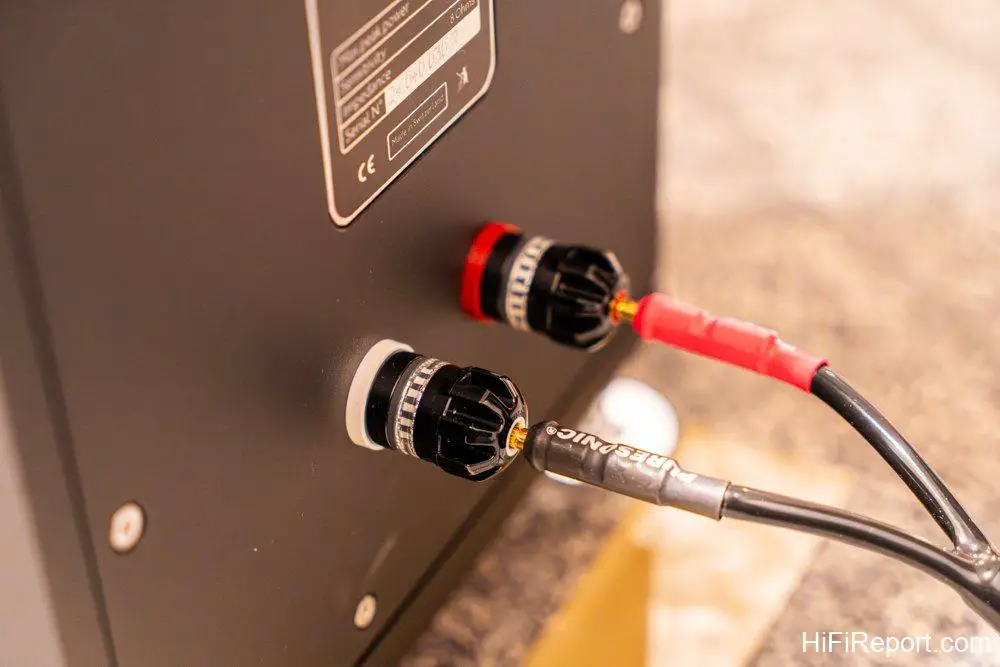
Since Stenheim’s speaker cabinets require screws for assembly, where are the screws? You won’t see them on the front, sides, or top. The answer is that some are located internally, and others are on the rear. By concealing the screws as much as possible, the speakers achieve a high-end aesthetic.
The speaker finish is also understated.
Stenheim speakers typically feature a sandblasted surface finish, with uniform paint that is free from impurities.
The Alumine 2.5 I listened to this time was black, so judging the paint quality might be tricky.
However, I previously heard the Alumine 5 and Alumine 2, both in silver (which the manufacturer calls light grey), and their surface finish was excellent.
Furthermore, the edges of the aluminum panels are beveled, and even areas without rounded treatment feel smooth to the touch, not sharp.
Close inspection of the aluminum panel joints reveals a consistent seam width along the entire length, indicating extremely high precision in their metalwork (or perhaps very stringent quality control).
High End products earn their designation through a commitment to meticulous attention to detail.
Aluminum Cabinet Advantage
Beyond aesthetics, speakers must sound good.
Their aluminum cabinets aren’t just for looks; they also have acoustic justifications.
Why choose aluminum? Because the material itself boasts high rigidity and sufficient mechanical strength, offering better control over vibrations compared to wood.
Some manufacturers argue that because musical instruments are made of wood, speakers should also be made of wood.
However, musical instruments and speakers have different sound production principles and cannot be equated.
Instruments aim for beautiful resonance, while speaker cabinets seek the opposite: minimal vibration. The cabinet should not “sing along” with the drivers.
This is precisely why Stenheim uses aluminum instead of wood for their cabinets.
Moreover, there are many aluminum alloys, and different compositions result in varying rigidity and density.
Many people believe aerospace-grade aluminum is the best, but it’s not necessarily an ideal material for speaker construction.
Stenheim tested vibration parameters of various aluminum alloy compositions, performed computer simulations, and relied on repeated human ear evaluations to select their specific aluminum alloy formula.
Once the material is chosen, a good structural design is essential to enhance overall mechanical performance and minimize cabinet vibration interference.
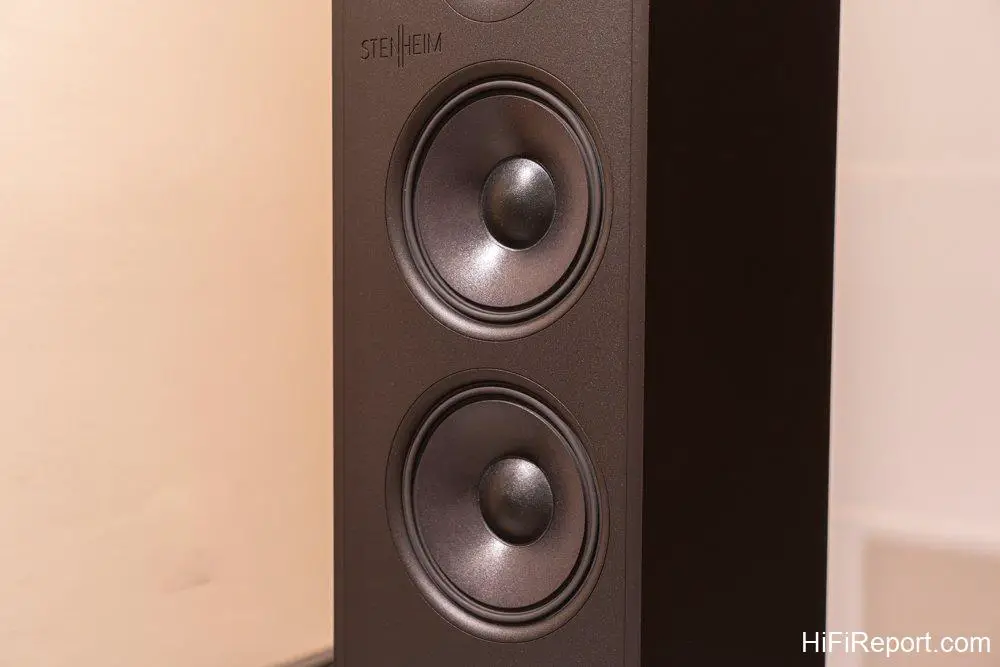
The speaker cabinet isn’t solely made of aluminum. Specific areas inside the cabinet are lined with damping materials to further suppress vibration.
Solving cabinet resonance issues yields another benefit. Compared to the MDF boards commonly used in wooden cabinets, which are often 18mm thick or more, aluminum panels are considerably thinner.
This allows the Alumine 2.5 to have a larger internal volume compared to a wooden speaker of the same external size, which is advantageous for low-frequency reproduction.
Driver Configuration
In terms of drivers, the Alumine 2.5 employs a 3-driver, 2-way configuration.
This might seem odd, given the model name “Two.Five.” Why isn’t it a 2.5-way design? Perhaps their response would be, “Well, the Alumine 5 isn’t a 5-way, is it?” Fair enough.
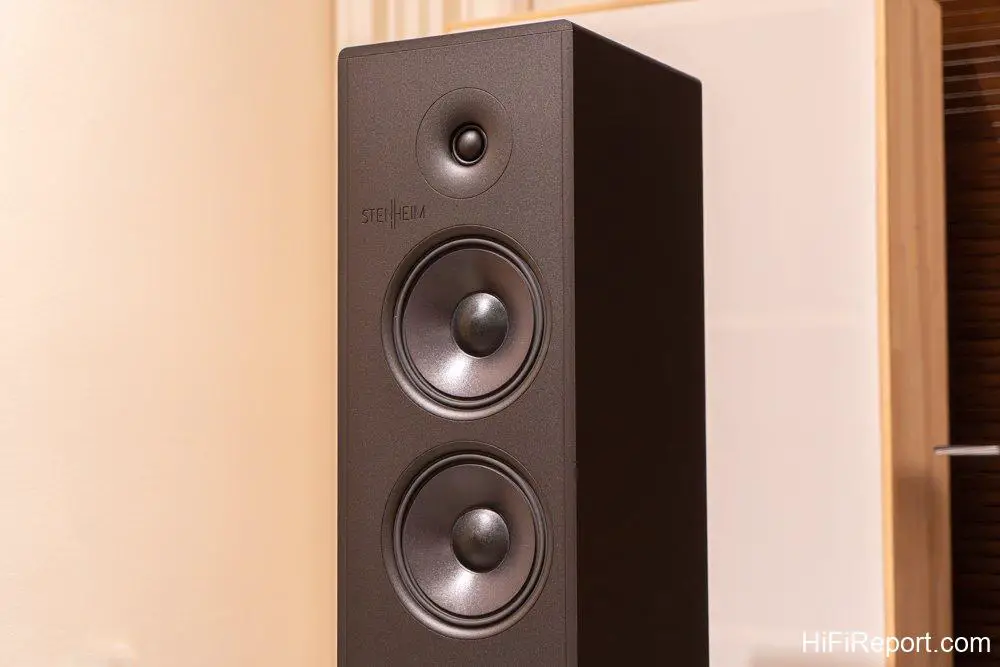
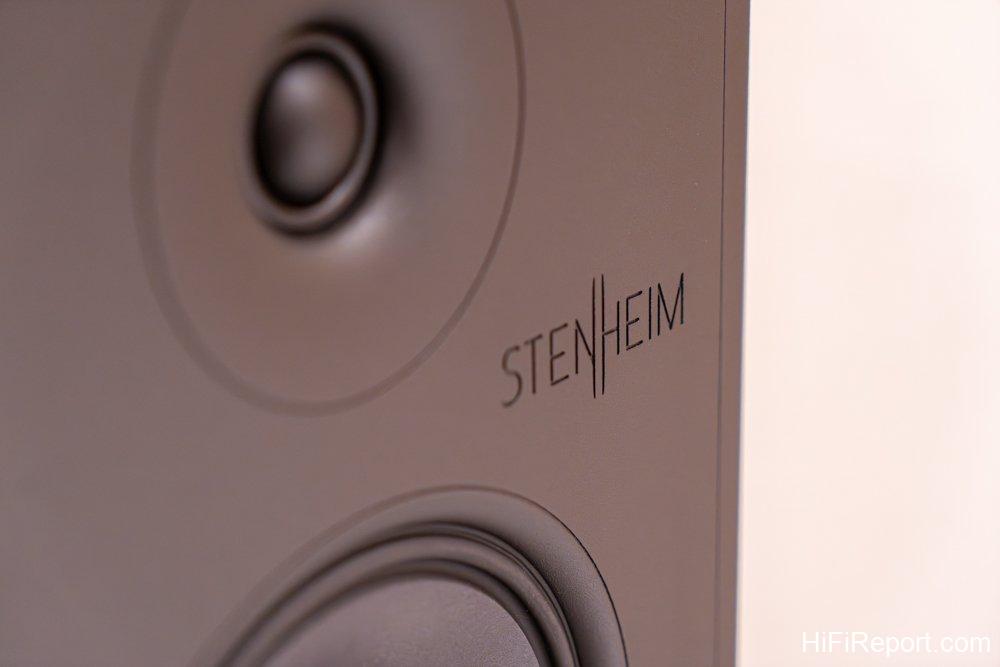
The Alumine 2.5 utilizes a single 1-inch soft dome tweeter from Scan-Speak. The opening features a shallow dish-shaped waveguide to control dispersion and enhance efficiency.
Below the tweeter are two 6.5-inch paper cone woofers custom-made by the French driver manufacturer PHL. These drivers feature a distinctive W-shaped (or double-layer) pleated surround.
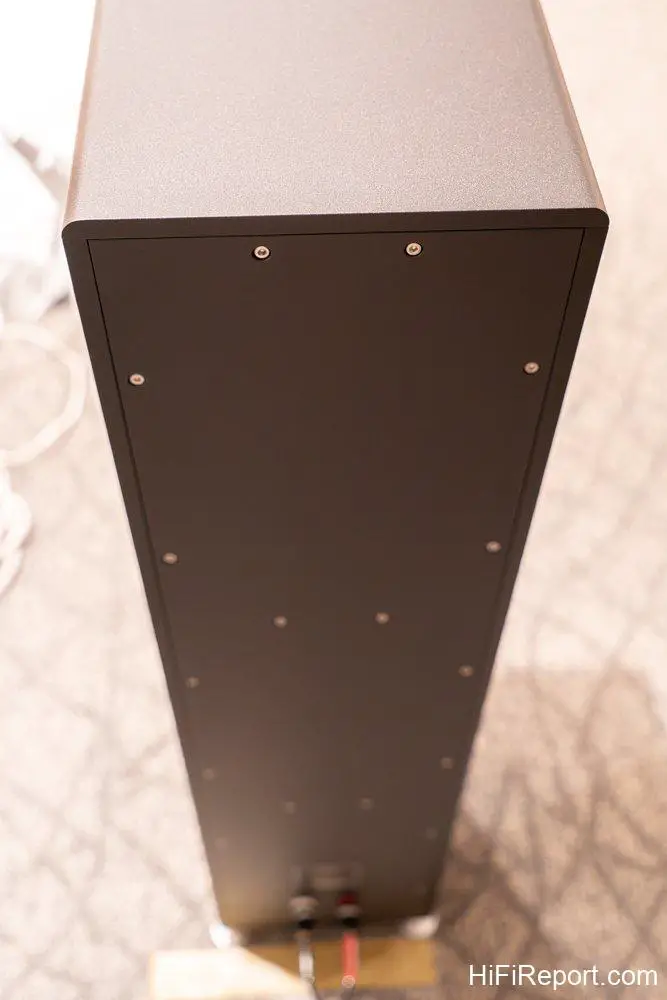
Stenheim’s principle for selecting drivers is clear: they must be highly efficient, fast in response, and operate linearly to produce a natural sound.
The driver layout is slightly off-center, which is a common technique used by Stenheim. Typically, speakers have drivers centered symmetrically, meaning they are not assigned to specific left or right channels.
When an off-center design is used, it usually only involves the tweeter being off-center, with other drivers remaining centered.
Mr. Yang of HiFiReport explained that because Stenheim speakers have an off-center design, they are specific to left and right channels. When placing them, the off-center side is always oriented towards the inside, with the engraved “Stenheim” logo on the baffle facing outwards.
Sensitivity and Placement
The Alumine 2.5 uses a second-order crossover network, incorporating many high-quality components like M-Cap capacitors.
Although the manufacturer doesn’t provide a diagram, Mr. Yang showed me a picture of the Alumine 2’s crossover on his phone, stating, “The Alumine 2.5’s crossover is even more complex than this.” Indeed, the Alumine 2.5 adds an extra driver compared to the Alumine 2. The manufacturer noted that the addition of this driver significantly increased the complexity of the crossover design. The requirements included not only precise phase but also maintaining Stenheim’s characteristic high efficiency.
In modern speakers, if the sensitivity reaches 89dB or 90dB, the manufacturer can confidently declare their speakers are highly efficient and easy to drive. This value typically appears on floorstanding speakers; smaller speakers with smaller drivers and cabinets usually have lower sensitivity.
However, Stenheim speakers consistently boast high efficiency. Taking the Alumine series as an example, the smallest model, the Alumine 2, is only about the size of a typical bookshelf speaker yet has a high sensitivity of 93dB. The flagship floorstanding Alumine 5 has a sensitivity of 94dB.
And the Alumine 2.5? Its sensitivity is also 93dB.
Stenheim intends the Alumine 2.5 to be very amplifier-friendly, stating it can be driven well with just 10W, sounding excellent even with tube amplifiers.
All Stenheim speakers feature a bass-reflex design, and the Alumine 2.5 is no exception. Like its younger sibling, the Alumine 2, it utilizes a circular port located on the front baffle. This facilitates easier placement for the user, without needing to worry about the distance from the rear wall.
Placement Suggestion
The listening session took place in the second-floor listening room at HiFiReport.
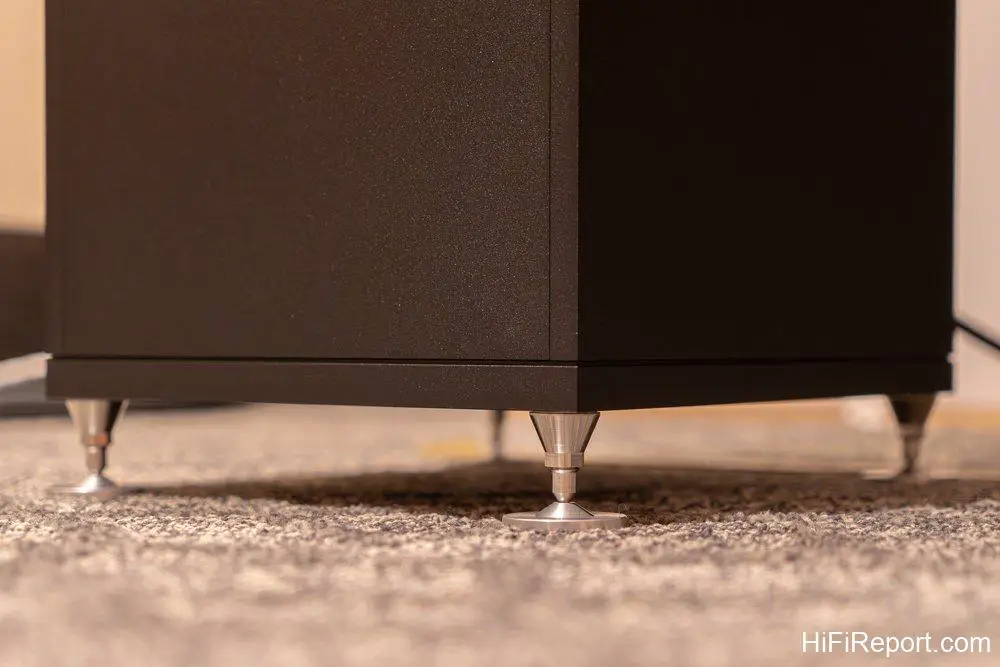
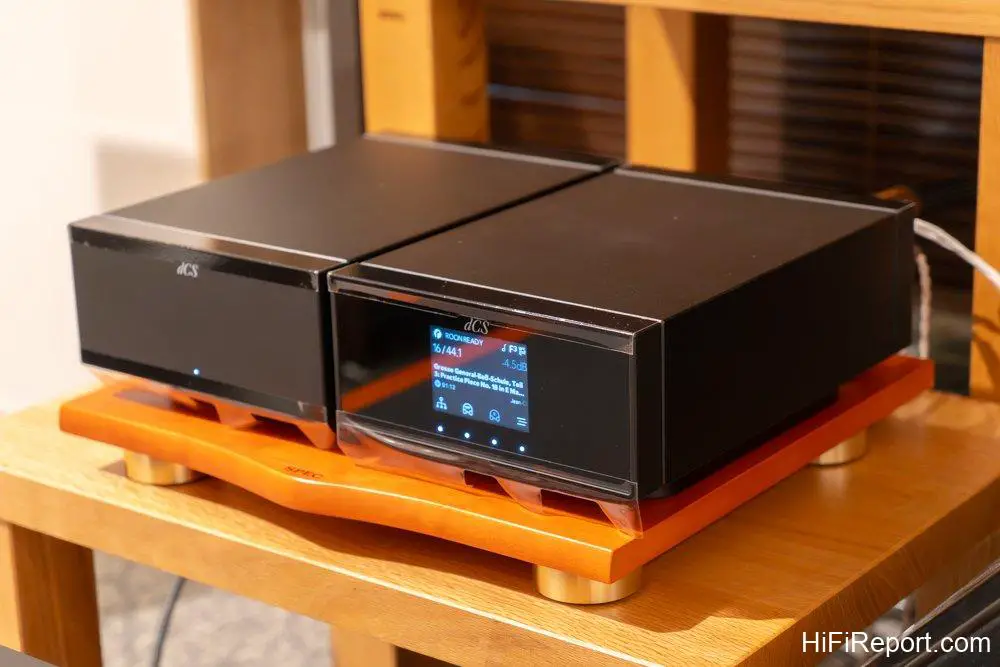
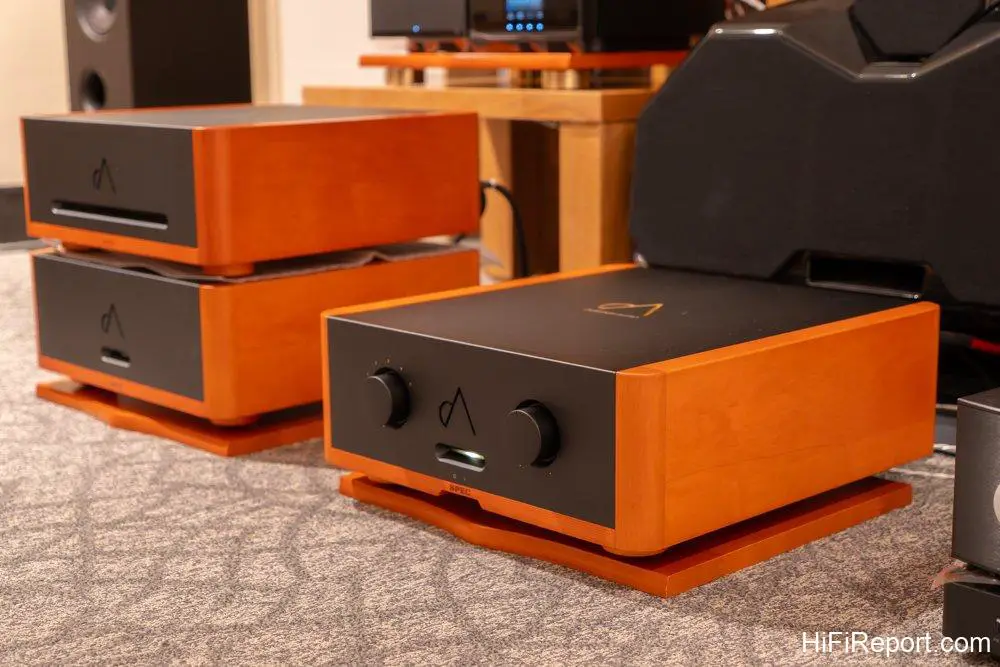
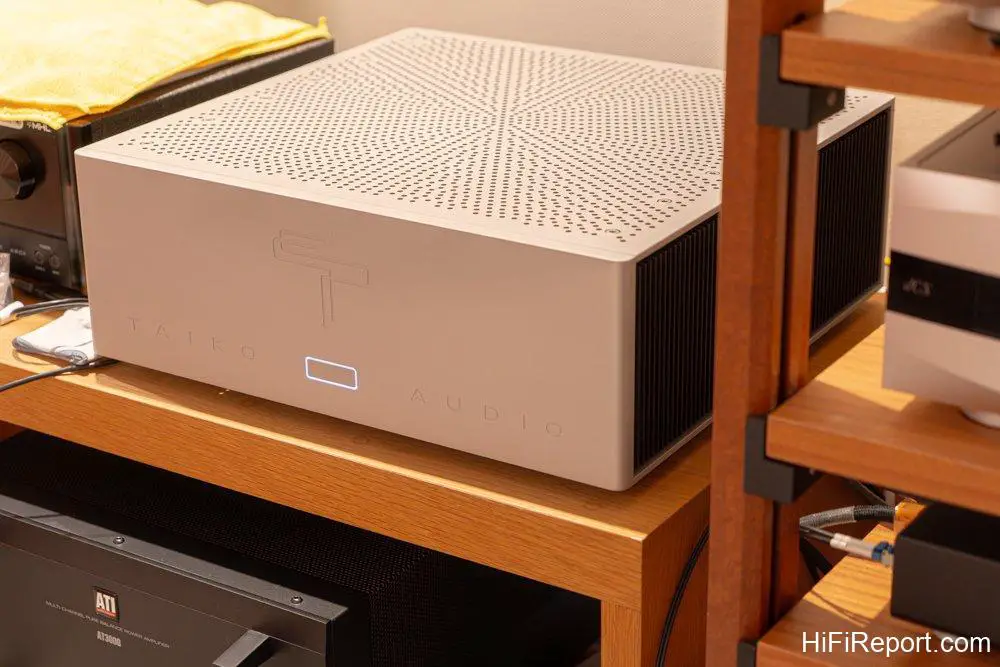
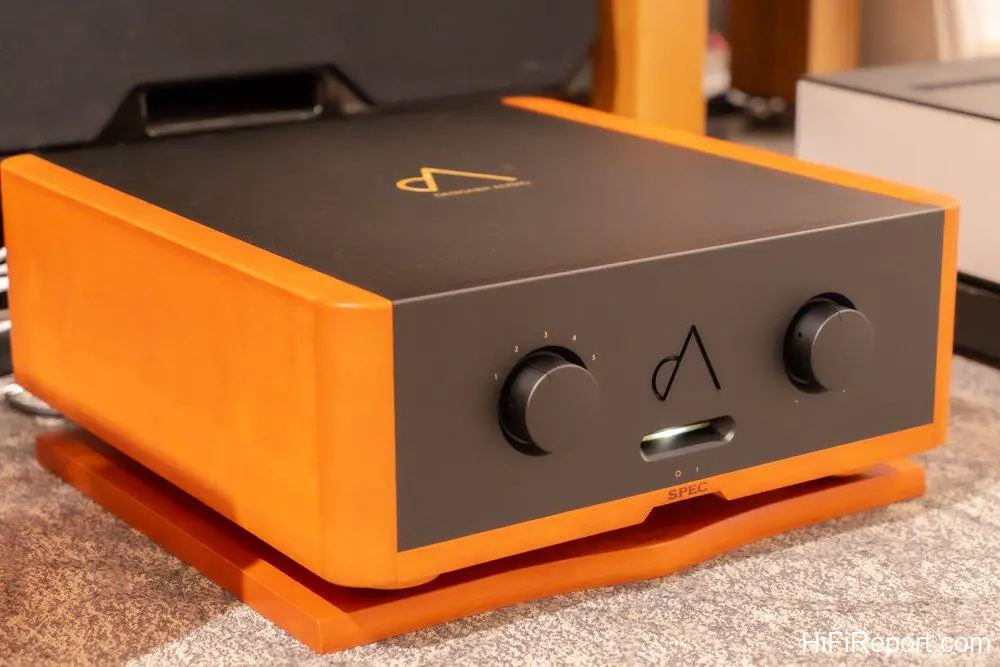
Mr. Zhang, the owner of HiFiReport (and the distributor for Bo-in Sound Technology), paired the Stenheim Alumine 2.5 with Spec’s latest flagship integrated amplifier, the RSA-EX1000. The source was a dCS Lina Network DAC streamer/decoder, augmented by a Master Clock. The Roon Server was a Taiko Audio Extreme music server.
Mr. Zhang placed the Alumine 2.5 quite wide apart, almost at the manufacturer’s recommended minimum distance of half a meter from the side walls, with a separation of approximately 3.2 meters.
Despite the Alumine 2.5’s small size, the manufacturer recommends users place the speakers at least 2.5 meters apart, and preferably between 3 to 4 meters if space allows.
Of course, this is the manufacturer’s recommendation. In a smaller indoor space, how to place the speakers requires personal consideration. The important goals are solid imaging and deep bass. Can such small speakers, placed so far apart, achieve this?
Vocal and Bass Performance
When playing Kyrie Kristmanson’s “Pagan Love” album, Kristmanson’s voice was clear, with precise articulation and diction. The imaging was focused and solid, and the sound quality was direct and natural. The Alumine 2.5 certainly has a talent for reproducing vocals.
The plucked bass in “Talk” had excellent texture, exhibiting both elasticity and power. The bass line wasn’t confined to the lowest register; it had its own melodic contour with rises and falls. Some of the low notes were indeed deep enough, while the higher notes, in addition to being taut and elastic, carried a touch of crispness. As for the finger snaps in “Song X,” they sounded crisp and remarkably lifelike. The drums were full and weighty, delivering impactful strikes. These two tracks alone were sufficient to dispel all my initial doubts.
Bass Purity
While listening to Kristmanson’s “Talk,” I thought of Diana Krall’s cover of “All or Nothing at All,” which begins with deep, full plucked bass. This bass passage is inherently well-recorded and often produces good bass quantity on many systems. However, the question is whether it’s genuinely deep bass or merely a labored, superficial low end. With bookshelf speakers or small floorstanders, if the manufacturer aims for bass quantity to create the impression of ample low end, they often end up making the speaker a “boom box.” Perhaps some people enjoy that plump, robust, thick, loose “booming bass.” But the Alumine 2 and Alumine 2.5 are different. Their bass delves deep naturally, reaching its limit gracefully without any artificial boosting or trying to sound bigger than they are. Listening to this song and the bass in “Talk,” you understand Stenheim’s fastidious approach to low frequencies.
Live Performance Magic
Stenheim speakers generally possess a lively character. Besides accurately reproducing the texture of voices or instruments, they have a knack for naturally revealing every detail. Every time I listen to Stenheim speakers, the music feels particularly vibrant and real.
Do you think by saying this, I’m implying the speakers are biased towards the midrange and treble, resulting in a thin sound? No, no, don’t jump to conclusions. What I mean is precisely what I’ve written: Stenheim speakers render textures naturally and clearly, with rich and authentic detail. I even believe the Alumine 2.5 and Alumine 2 are speakers with significant monitoring capabilities – they can restore virtually all information from the recording directly, uncolored, and unadorned.
Take “Belafonte: At Carnegie Hall,” a live concert recording, as an example. Harry Belafonte’s voice is warm and full-bodied, with robust power, and his spontaneous performances on stage ignite a fervent atmosphere in the hall. How much of that live atmosphere is reproduced? The widely spaced Stenheim Alumine 2.5s, combined with their excellent dispersion, create a broad soundstage. Don’t let their size fool you; despite being small floorstanders with modest driver dimensions, the Alumine 2.5 delivers the typical Stenheim ease. This recording conveys a strong sense of being present at the event. Every element is revealed: Belafonte’s movements on stage, his singing expressions and inflections, the localization of accompanying instruments, the audience interaction sounds, and the reverberation included during recording and mixing.
For instance, in the opening track “Darlin’ Cora,” the audience’s thunderous applause, along with the guitar and drum accompaniment, and Belafonte’s powerful, impassioned, and evocative singing are all clearly reproduced. Or consider “Cotton Fields,” where the richness of the accompanying instruments is layered gradually, and Belafonte’s vocal intensity progressively increases. His clever phrasing, slurring, elastic tempo, and improvisational variations create a naturally flowing, dynamic performance.
In the dove song, “Cu Cu Ru Cu Cu Paloma,” the musicians join in harmony, building a layered and echo-like texture. The whistling imitating bird sounds is particularly delightful; listening to this lively whistling, one must truly admire Stenheim’s top-notch sense of realism.
As for “Matilda,” it’s a prime example of his captivating stage spontaneity. Belafonte leads not only the stage musicians but also the entire audience in singing along. Listening to this scene of audience and performers united in the second-floor listening room at HiFiReport, together with the two owners (of HiFiReport), felt like being transported back to that Carnegie Hall performance 65 years ago.
Piano Rendition
Although the Alumine 2.5 is small, it handles piano reproduction admirably. While it may not rival the scale, authority, and weight of the larger Alumine 5 or even the Reference Ultime Two, without direct comparison (where there is no perceived “harm”), it is entirely sufficient to appreciate the various facets of piano performance.
Using Danilo Rea’s “Lirico” album as an example, where he arranges famous opera excerpts into jazz-style piano pieces, a single piano manages to convey a wide range of emotional tension. In the aria “Mon cœur s’ouvre à ta voix” from Saint-Saëns’ opera “Samson and Delilah,” the left hand reaches down to the lowest octave to play weighty chords, while the right hand ascends with a fluid melodic line. The layering between voices is clear. Unlike some speakers that apply a slightly soft, colored brushstroke to the upper midrange and treble to make the highs sound sweeter, which can be appealing, the Alumine 2.5’s piano sound is direct, natural, and unembellished. The colorations others might consider beautiful are, to it, not sincere enough.
As the piece develops towards the end, there is a section with alternating low chords and tremolos. The attack of deep, heavy, rich bass is uncommon for a speaker the size of the Alumine 2.5, which manages to produce low frequencies that are both deep and remarkably clear. Considering Mr. Zhang of HiFiReport’s placement with a spacing of over 3 meters, the Alumine 2.5’s ability to still deliver such solid, focused, and weighty piano sound is genuinely impressive.
Orchestral Scale
Open-sounding and energetic, the Alumine 2.5 is also spectacular with large-scale orchestral music. Listening to Alice Sara Ott playing Tchaikovsky’s Piano Concerto No. 1, in the opening of the first movement, after the brass introduces the four-note descending motif, the strings play the first theme accompanied by the piano’s powerful, resolute chords. The piano then takes the lead, and the musical expression becomes even richer. A passage follows where the piano notes descend, followed by rapid ascending arpeggios. Just this opening section, both the piano and the orchestra, are breathtaking in their grandeur.
The Alumine 2.5 presents the piano sound with solid focus and clear articulation. While that is notable, what is truly beautiful is the brilliant tone, the shimmering luster with a hint of liquid texture. I have listened to Stenheim speakers several times: the Alumine Two, Alumine Five, and even the flagship Reference Ultime Two. Regardless of size, Stenheim speakers possess an exceptional, innate beauty, a clear and charming quality. Scale is one thing – naturally, larger speakers offer greater scale. But their larger speakers can exhibit a sense of noble quality, and the smaller ones display similar refinement. Larger speakers can project magnificent presence, and the smaller ones are not far behind.
Detail and Clarity
Listening to Valery Gergiev conducting the Mariinsky Orchestra in Tchaikovsky’s “Romeo and Juliet Fantasy Overture,” whether the music is profoundly introspective or intensely impassioned, the Alumine 2.5 consistently conveys the required character and emotional impact. This fantasy overture was a work Tchaikovsky contemplated for a long time, and here, the composer, known for his melodies, demonstrates his ability to narrate through music. Following a section dedicated to Friar Laurence’s theme, the music transitions to the family conflict theme; the former is distant and mysterious, while the latter is passionate and emotionally charged.
The Alumine 2.5 acts like a watchmaker, disassembling the various musical parts, cleaning and oiling them, and then reassembling them. The musical layers are clear. Even during busy orchestral passages, the clarity remains undisturbed, maintaining the smooth texture and delicate beauty of the sound. In the love theme section of Romeo and Juliet, the slender strings shimmer and sparkle, representing the entangled passion high in the clouds, under a starry archway. Whether it’s pizzicato strings or light timpani taps, even subtle sounds are conveyed precisely by the Alumine 2.5, provided they were captured in the recording. This truly makes me praise its exceptional monitoring capability.
System Synergy
Precisely because of its excellent monitoring capability, it can clearly reveal differences in the upstream equipment. All the listening impressions mentioned earlier were obtained using the Spec RSA-EX1000. Although the Spec is a solid-state amplifier, and a Class D design at that, its sound possesses a sweetness, vibrancy, and liveliness reminiscent of single-ended triode tubes, while offering significantly more power, making it effortless to drive speakers.
Swapping to a different amplifier immediately changed the sound. After removing the RSA-EX1000 and installing the Mola Mola Kula integrated amplifier, the transparency and resolution improved further. Mola Mola’s owner, Bruno Putzeys, is a master of Class D amplification. Many well-known Class D brands and models like UcD, Hypex, NCore, Purifi are associated with him. Although both Mola Mola and Spec use Class D amplification, we can broadly categorize the former as technically oriented and the latter as having a tuning focus, resulting in distinctly different flavors of Class D amplifiers.
The moment the Alumine 2.5 was connected to the Kula, the sound immediately became refined and focused, incredibly transparent, incredibly fast, and teeming with details. The Alumine 2.5’s monitoring character was evident here too; it reproduces whatever you feed it. No matter how much detail or how fast the signal, it handles it without issue.
Conclusion
Have you ever heard Stenheim speakers? You really should; and the Alumine 2.5 is an excellent starting point. If you have, you’ll understand the kind of clean transparency I’m describing. You’ll understand why I kept praising its lively sound and excellent atmosphere. You’ll also know why I say it can produce a large-scale presentation disproportionate to its size, and is capable of reproducing the scale and weight of a grand piano.
Perhaps it is small in size, and perhaps it looks understated. If you spend the same amount of money on speakers from other brands, you might find larger, more imposing speakers. However, if you listen to them, you will realize that Stenheim speakers are truly extraordinary – the small ones are capable, and the price is justified.
Specifications
* Type: 3-driver, 2-way, bass-reflex speaker
* Drivers: 1 x 1-inch tweeter; 2 x 6.5-inch woofers
* Sensitivity: 93dB
* Impedance: 8 ohms
* Power handling: 125W RMS (250W peak)
* Minimum recommended amplifier power: 10W
* Dimensions: 945 x 230 x 275 mm (HxWxD)
* Weight: 45kg